Charoite
Please consider my idea for a Russian regional postage stamp featuring charoite mineral. I was born and raised in Siberia, have a deep love for this gemstone, and consider it an important part of the region’s identity.
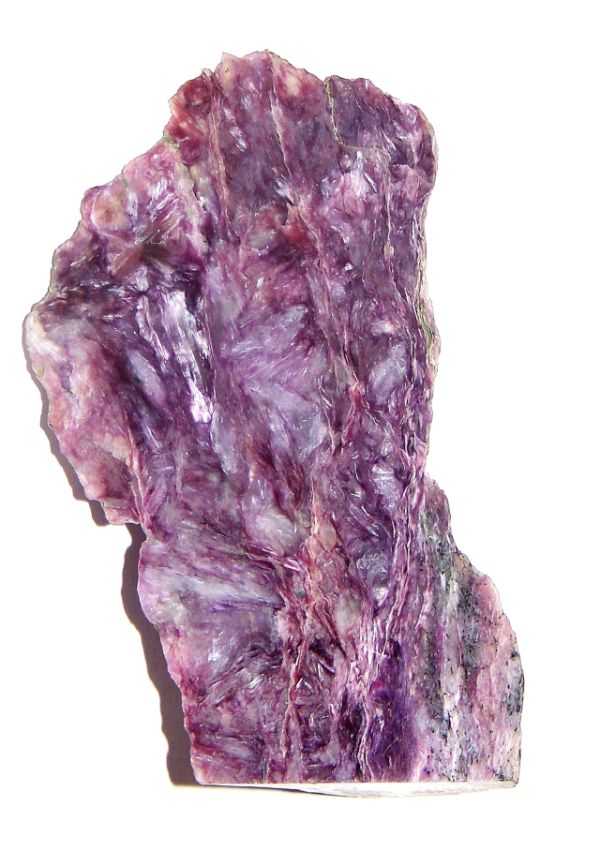
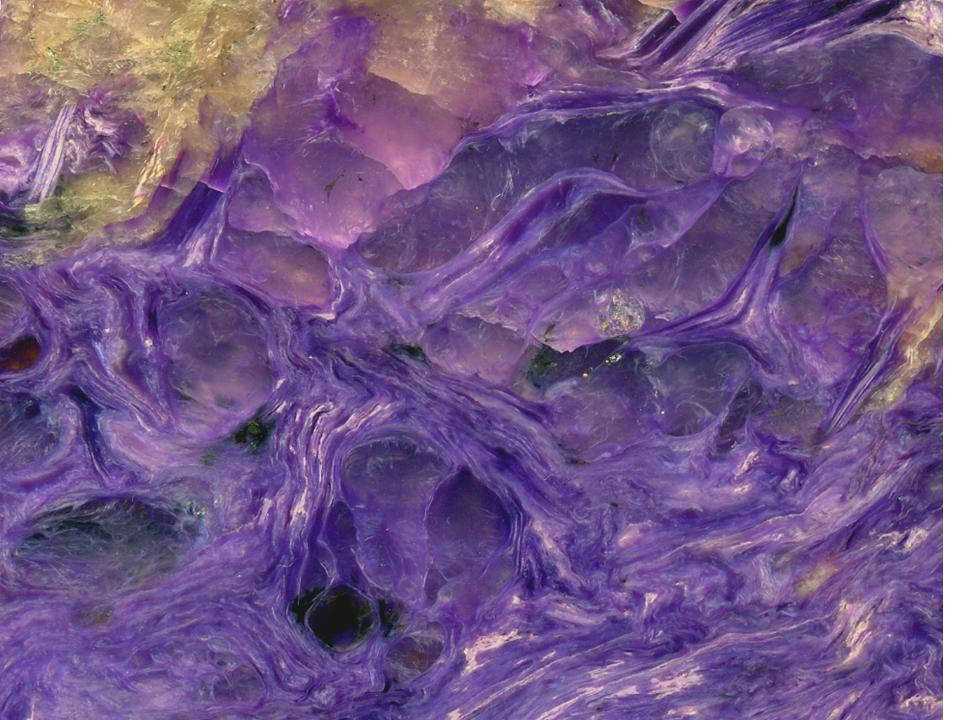
Charoite is a rare silicate mineral, first described in 1978. It is named after the Chara River, despite its being 70 kilometres (43 mi) away from the discovery place. When it was discovered, it was thought to be a fake, dyed purple to give it its striking appearance.
History and Discovery
Charoite was first discovered during a geological survey in 1948 by Soviet geologist Vladimir G. Ditmar, who mistakenly identified it as cummingtonite schist.
The only known commercial deposit of charoite was discovered in 1960 by Yuri and Vera Rogov, graduates of the Irkutsk Polytechnic Institute. It is located on the border between Irkutsk Oblast and the Sakha Republic (Yakutia), both in Siberia, Russia. The deposit lies within a fault zone of the Baikal Rift System, near the watershed between the Chara and Tokko rivers. It was named Sirenovy Kamen (literally, "Lilac Stone") after the distinctive purple colour of the mineral.
Mining began in the early 1970s, around the same time charoite gained international recognition. According to a well-known story, Yuri Rogov, the deposit's discoverer, was once sent abroad on an official government mission. During his trip, he visited the mineralogical museum at the Louvre in Paris, which claimed to possess a complete collection of all minerals known on Earth. Rogov showed the museum staff a polished slab of the unusual lilac-coloured rock and asked them to identify it. They had to admit that the mineral was not represented in their collection and even offered to buy the specimen from him. The Soviet geologist declined.
The first pieces of jewellery made from charoite appeared in 1973.
Charoite was officially recognised and registered as a new mineral in 1977 by Vera P. Rogova. While scientists were still studying the newly discovered mineral, jewellers had already begun cutting, polishing and selling it as an ornamental gemstone.
The gemstone soon became so popular that many charoite items were exported abroad. An American scientist obtained a specimen of Soviet charoite, studied it in the United States and submitted an application to the International Mineralogical Association's Commission on New Minerals, hoping to establish priority for the discovery.
However, Vera Rogova, a researcher from Irkutsk, had submitted her application slightly earlier. Her original proposal was rejected because the name she suggested, charait, was considered too similar to the name of another mineral, cheralite. She was asked to choose a different name.
Eventually, recognition went to Rogova: all but one member of the commission supported awarding her credit for the discovery. The American mineralogist subsequently wrote to his Siberian colleague to congratulate her.
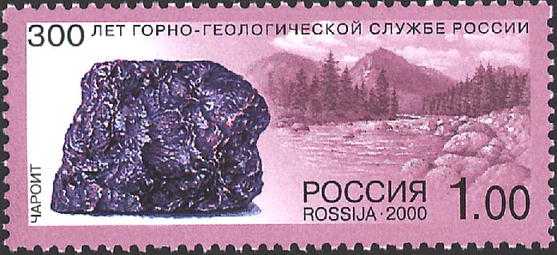
Charoite depicted on a Russian postage stamp.
Mining and Availability
The most valuable specimens of charoite are found in the Sakha Republic (Yakutia), in northeastern Siberia. The regional government imposes an annual extraction limit of approximately 100 tonnes to protect this rare gemstone deposit. Commercial mining in Irkutsk Oblast has virtually ceased.
Several theories regarding the geological origin of charoite have been proposed by researchers, including E. I. Vorobyov, N. V. Vladykin, M. D. Evdokimov, V. M. Biryukov and N. V. Berdnikov.
Uses and Characteristics
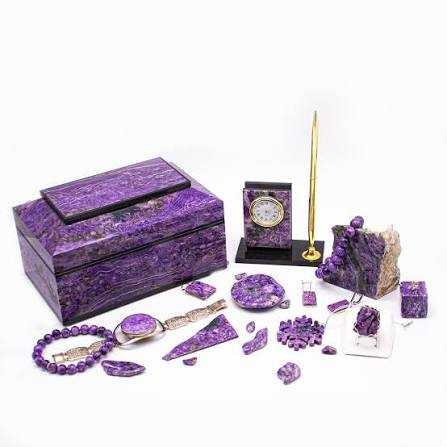
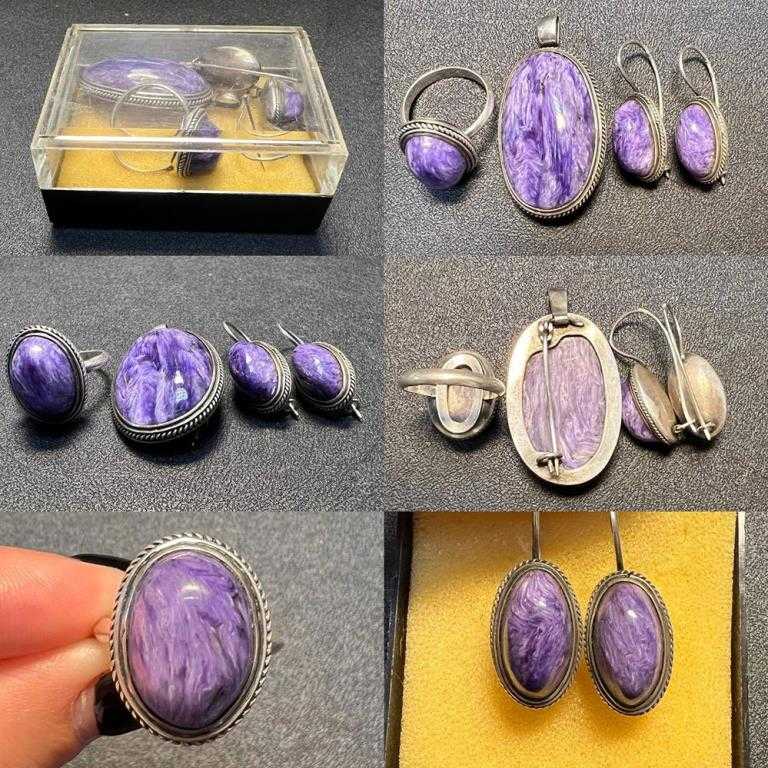
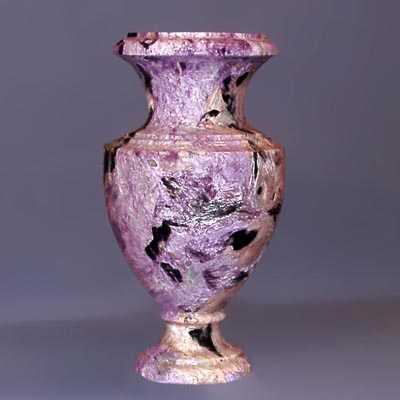
Charoite's natural decorative appeal, durability and ease of cutting and polishing make it suitable for a wide range of jewellery and ornamental objects. It is used to create vases, bowls, bracelets, rings, pendants, earrings, brooches, cufflinks and other decorative items.
More than 100 varieties of charoite are recognised, differing in colour and pattern. Its broad palette makes it particularly popular in decorative mosaic art, including poured-stone and Florentine mosaic techniques.
The gemstone's availability is limited by the extraction quota imposed by the government of the Sakha Republic, which is intended to prevent the deposit from being depleted too quickly. As a result, charoite has become increasingly rare and its market value has tended to rise over time.
Market prices have been reported at approximately $30–70 per kilogram, depending heavily on quality. Exceptional, top-grade specimens can cost more than $100 per kilogram.
Although purple is the most familiar colour, charoite also occurs in less common shades, including crimson, brown and grey.